

Galicia

Presentation of the Region
One of Spain’s 17 autonomous regions. Located in the north west of the Iberian Peninsula, it covers 29,574 km², and has 2,700,269 inhabitants. It is a unique region with its own language and distinctive culture and is home to Santiago de Compostela, the destination of more than quarter of a million souls who travel each year along the Camino de Santiago pilgrim trails. Its wild coastline is frayed up and down its 1200km length by rías (coastal inlets), and strung with cliffs, beaches, islands and fishing ports. Inland is a labyrinth of deep-green valleys, speckled with stone villages, medieval monasteries and age-old vineyards.
Galicia strongly depended on agriculture and fishing until the 80´s last century. Reflecting that history, the region has the largest fishing fleet in Europe. Nonetheless, today the service sector occupies more than 50% of workers.
Industry is specially strong in shipbuilding, fashio-textiles, agrofood, energy (specially hydroelectric and wind power), wood processing and car manufacturing. STELLANTIS N.V. centre in the region since 1958, makes about 450,000 vehicles annually. Galicia is also the headquarters of Inditex, the world’s largest fashion retailer; of their eight brands, Zara is the best-known. In recent years, Galicia has also become a significant tourist destination, with more than 5 million visitors in 2019.
RIS3 Priorities
The region has had a RIS3 in place since 2014, which is being re-shaped for the period 2021-2027. The Strategy has been defined around 3 main challenges and 10 priorities:
1. The innovative management of natural and cultural resources: Sea-Valorization, Aquaculture, Biomass and Marine Energy, Primary Sectors Modernisation, ICT Tourism
2. The future industrial model of Galicia: Diversification of Driving Sectors, Competitiveness in the Industrial Sector, Knowledge Economy: ICT & KETs
3. A new healthy lifestyle model base don active ageing: Active Ageing, Food & Nutrition
This Strategy has been complemented by the Galicia Innova 2020 Plan, which is a framework designed to reinforce the region R+D+I policy and help achieve the objectives of the RIS3 2014-2020.
Political Representatives
Román Rodríguez
Regional Minister of Education, Science, Universities and Vocational Training
Regional Contact Persons
Sabela Pardo Rodríguez
Brussels Contact Persons
Manuel París Lestón
R&D&I and European Programmes Manager
Regional Address
Rúa Airas Nunes s/n 15702 Santiago de Compostela A Coruña Spain
Brussels Office Address
Rue de la Loi 38, 2 1040 Brussels Belgium


Latest Updates

New Vi Pilot Hydrogen Officially Live
On Thursday 29 September, the newVI Pilot on Hydrogenwas officially launched.The inaugural kick-off took place during the second day of the 11thInternational Trade Fair of Materials Technology, Technologies, and Composite Productsin Kracow. The new H2 Pilot is an interregional project which brings t…

Cross Regional Cooperation Alpine Regions Ardianet Project Or How Share Capacities And Bring
the ARDIA-Net project stands forAlpine space Research, Development and Innovation Area. It started in 2019 with the objective to create effective cross-regional RDI governance and funding schemes across the Alpine region to overcome the identified funding gaps. In June 2022 the project’s final resul…
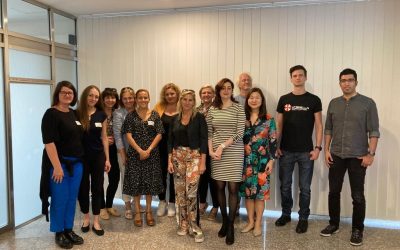
Science Meets Regions Vi Regions Together Lower Austria Accelerate Digital Transition Health
On September 7 and 8, more than 70 people including members of public authorities, doctors, university professors and representatives from the private sector, attended the third regional event of theVI Innovation Networking Initiativeseries on the acceleration of the digital transition in health.The…